New to staffing? This is the whole business on one page, in plain words, before you learn the screens.
Summary
A staffing agency finds workers for businesses that need them. The business is the client. The worker is a Crew Member. The agency recruits and onboards the Crew, fills the client's jobs, tracks the hours, pays the Crew and bills the client. The agency earns the difference between what it bills and what it pays. What trips new people up: the words. Pay rate, bill rate, markup and margin all sound alike, and they mean different things.
Every job, in six steps
- Recruit: people apply and become candidates.
- Onboard: candidates sign their documents and prove their credentials.
- Take the order: a client asks for people, on given days, at a given place.
- Fill it: you offer the jobs to qualified Crew, and they confirm.
- Track the time: Crew clock in and out, and someone approves the hours.
- Get paid: you pay the Crew and invoice the client.
The business on one page
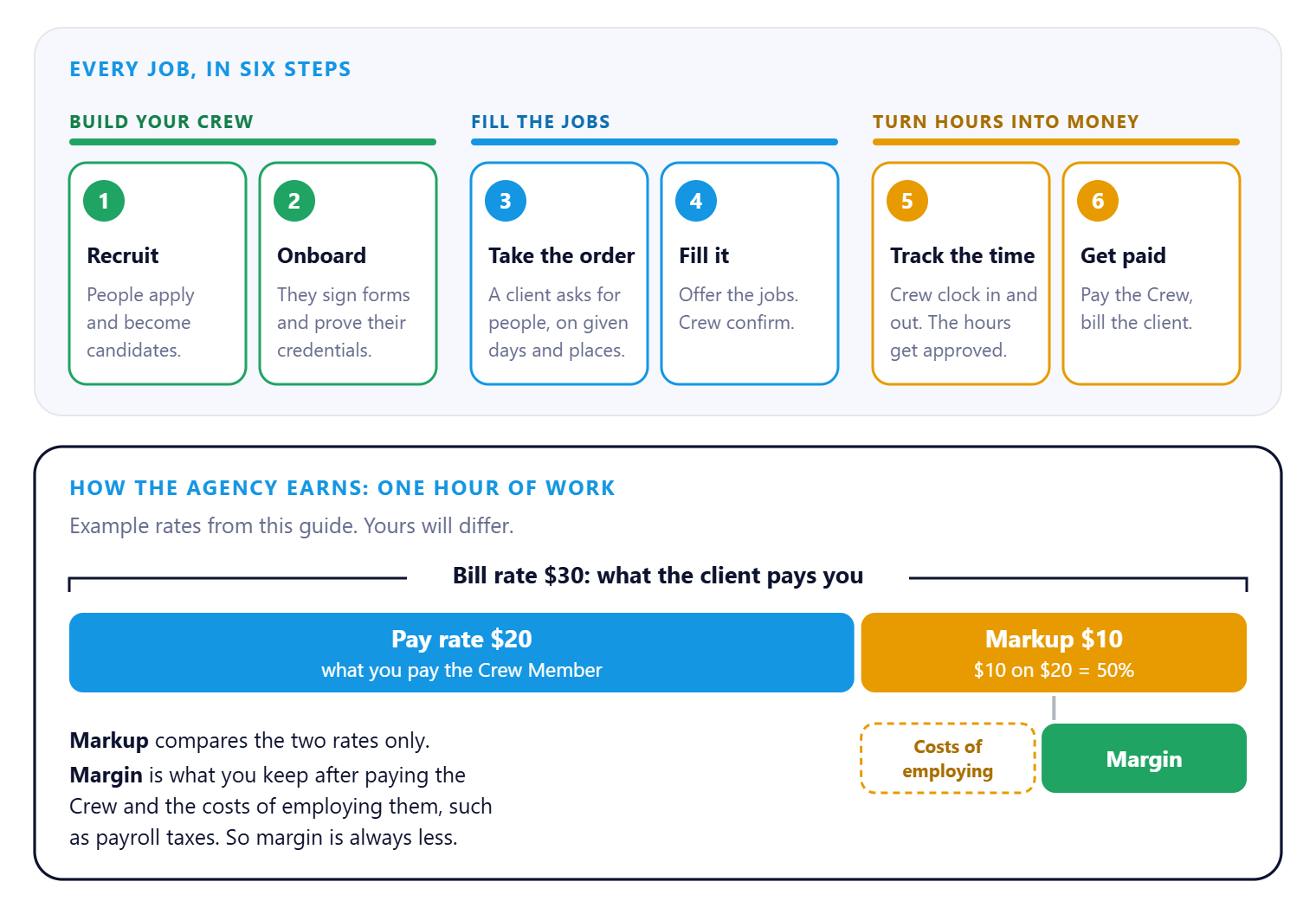
Six steps take a person from applicant to paid, and a client from request to invoice. Underneath it all, you bill the client more per hour than you pay the Crew Member. Markup compares those two rates. Margin is what's left after the costs of employing them, which is why it's always smaller. The rates are this guide's example.
That's the business. Read on for who does what, and the words you'll hear in your first week.
On this page
Three parties in every job
| Who | What they want | What they do |
|---|---|---|
| The client | The right people, on time | Orders staff, directs the work on site, approves hours, pays the invoice. |
| The Crew Member | Work that fits their skills and schedule | Takes jobs, turns up, clocks in and out, gets paid by the agency. |
| The agency (you) | Filled jobs, paid on time | Finds and qualifies Crew, fills orders, runs payroll and invoicing. |
Examples: a hospital needing nurses for a weekend, an arena needing event staff for a concert, a warehouse needing forklift drivers for peak season.
The six steps, and where they happen in NextCrew
| Step | The old way | In NextCrew |
|---|---|---|
| Recruit | Paper applications typed into a spreadsheet | Candidates apply online and their record is created for you. See How Candidates Find You and Apply. |
| Onboard | PDFs emailed back and forth, signatures chased | Documents go to the candidate's phone to sign, and licenses are tracked with their expiry dates. See Send Onboarding Documents and Track Licenses and Certifications. |
| Take the order | A phone call written on a notepad | You create the order, or the client places it in their own portal. See Place an Order for Staff. |
| Fill it | Calling and texting people one by one | You choose who hears about the job, and Crew confirm in the app. See Choose Who Hears About a Job. |
| Track the time | Paper sign-in sheets added up by hand | Crew clock in on the app, and you see who's on site today. See Clock In, Clock Out and Add Breaks and See Today's Timesheets with Daily Pulse. |
| Get paid | Hours typed into payroll, then typed again into invoices | Approved timesheets feed the payroll export and the invoices. See Export Payroll to Your Payroll Company and Create Invoices in a Batch. |
Every hour gets entered once. That's where the time goes back to your team.
Words you'll hear in week one
| Term | What it means | Example |
|---|---|---|
| Pay rate | What you pay the Crew Member per hour. | $20 an hour |
| Bill rate | What you charge the client per hour for that person. | $30 an hour |
| Markup | How much the bill rate is above the pay rate, as a percentage of the pay rate. | $10 on top of $20 is a 50% markup |
| Margin | What the agency keeps after paying the Crew and the costs of employing them, such as payroll taxes. | Always less than the markup |
| Order, job, offer | The client's request, each position on it, and each person asked to work it. | See Orders, Jobs and Offers |
| No-show | A booked Crew Member who doesn't turn up. | |
| DNR (do not return) | A client asks not to have someone back. In NextCrew this is Not Allowed. | See Track Preferred and Not Allowed Crew |
| Fill rate | How many of the people asked for were provided. | 9 of 10 is a 90% fill rate |
| Time to fill | How long it takes to fill an order after it comes in. |
Where to go next
Read How NextCrew Works: The Big Picture to see one job move through the screens. Then follow Guides for Staffing Agencies: Start Here for the areas you work in.
Questions people ask
Who pays the Crew Member?
The agency. The client pays the agency.
Why is margin smaller than markup?
Markup only compares the two rates. Margin also takes out what it costs to employ the person.
Is a candidate the same as a Crew Member?
A candidate has applied. Once they're onboarded and hired, they're a Crew Member.
Other ways people ask this
- How does a staffing agency make money?
- What is the difference between markup and margin?
- What is a bill rate?
- What does DNR mean in staffing?
- How does temp staffing work?
Related guides
- How NextCrew Works: The Big Picture — one job through the screens
- Orders, Jobs and Offers: How They Fit Together — the three words in detail
- Guides for Staffing Agencies: Start Here — what to learn next
- Track Additional and Burden Costs to See Your True Margin — the real margin on a job
Was this article helpful?
That’s Great!
Thank you for your feedback
Sorry! We couldn't be helpful
Thank you for your feedback
Feedback sent
We appreciate your effort and will try to fix the article